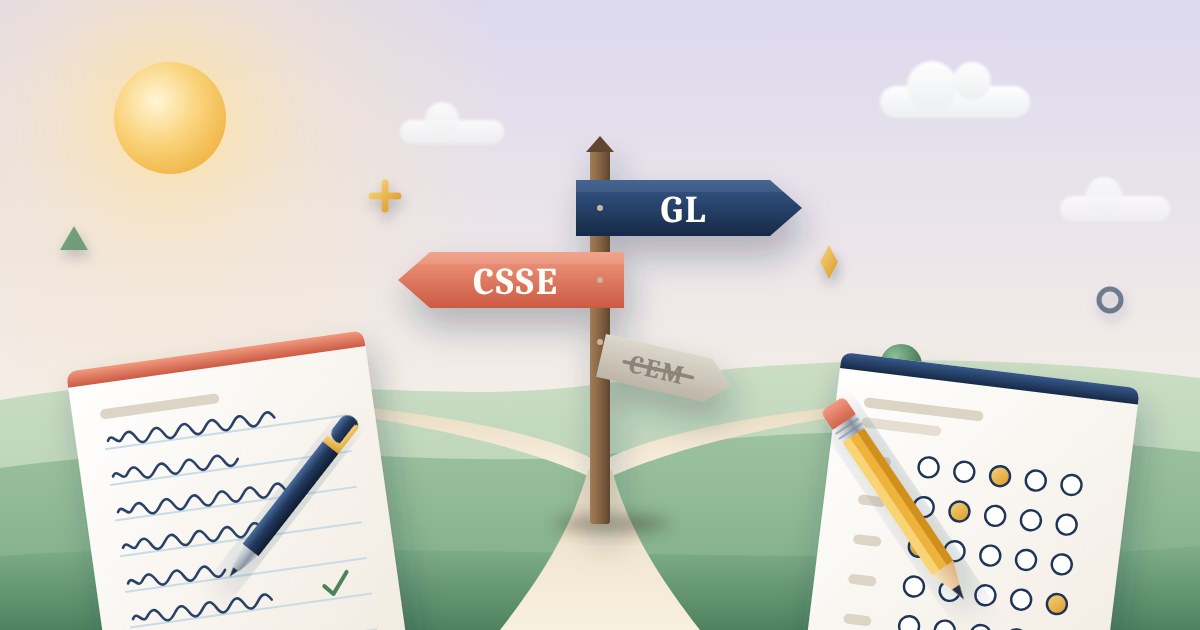
Search for 11+ practice books and you will quickly meet labels such as "GL", "CEM" and "CSSE". They matter, because each name stands for a different style of test, and practising the wrong style wastes precious months.
The first thing to know about the GL vs CEM 11 plus debate is that, for state grammar schools, it is largely settled. CEM-branded 11+ papers are no longer used for state grammar school selection, so the areas that once used them now use other tests. If you are buying books labelled "CEM-style" for a state grammar school, check the current test first.
What matters now is the format your child will actually meet, and for families around East London that usually means one of three: GL Assessment, the Essex CSSE test or a school's own paper.
11+ exam boards: why there are different tests at all
There is no national 11+. Each local authority, consortium or school decides what to test and who supplies the paper. Parents often call the organisation that writes the test the "exam board", although the 11+ is not run by the boards that set GCSEs.
| |
GL Assessment
|
CSSE (Essex)
|
School's own test
|
ISEB Common Pre-Test
|
|
Used near East London by
|
Redbridge grammar schools; Latymer's maths and verbal reasoning paper (Edmonton)
|
Ten selective schools in Chelmsford, Colchester, Southend, Westcliff and Shoeburyness
|
e.g. Chelmsford County High School for Girls; Latymer's English paper
|
Independent schools that use it
|
|
Subjects
|
English, maths, verbal and non-verbal reasoning, combined differently by area
|
English (reading and writing) and maths
|
Varies by school
|
English, maths, verbal and non-verbal reasoning
|
|
Answer format
|
Multiple choice
|
Mostly written answers
|
Varies
|
Online, multiple choice, adaptive
|
|
Typical scoring
|
Standardised scores; local qualifying score
|
Two standardised scores combined; minimum 303 for an offer
|
Varies
|
Results can be shared with several schools
|
GL Assessment 11+ tests
Redbridge Council describes GL Assessment as "the UK's leading provider" of 11+ entrance exams. GL papers can cover English, maths, verbal reasoning and non-verbal reasoning, but each area chooses its own mix and timings.
In Redbridge, for instance, Redbridge Council describes two papers: English with verbal reasoning, and maths with non-verbal reasoning.
GL's own familiarisation materials use a multiple-choice layout. That changes how children should practise: only the selected answer counts, accuracy in marking answers matters, and an educated guess usually beats a blank. At Latymer, for example, the school explains that GL answer sheets are marked by machine.
The CSSE 11+ format
The Consortium of Selective Schools in Essex sets one test for its member schools. According to its 2027 entry information guide, there are two papers:
Each paper is standardised and worth 50% of the total. Unlike GL, the CSSE papers ask for written answers: in the most recent past papers CSSE has published (for 2023 entry), children write short answers to comprehension questions, complete two short pieces of continuous writing, and write their answers to maths problems in answer spaces. CSSE removed its "applied reasoning" questions from the English paper from 2025 entry onwards, so there is no separate reasoning section to prepare for.
Schools that set their own tests
Some grammar schools run their own process or add their own paper:
-
The Latymer School, Edmonton: candidates sit a maths and verbal reasoning paper set and scored by GL Assessment, and a written English paper set and marked by the school. In the school's published procedures for recent years, only the English papers of the highest-ranked candidates on maths and verbal reasoning (the top 700) were marked. Check the current procedures before you apply.
-
Chelmsford County High School for Girls: not part of the CSSE. Its 2027 admissions policy describes a test covering Key Stage 2 subjects plus a creativity element.
ISEB Common Pre-Test
The ISEB Common Pre-Tests are four online, multiple-choice, adaptive tests in English, maths, verbal reasoning and non-verbal reasoning, used by independent schools for Year 7 (and delayed Year 9) entry. They are not used for state grammar schools, so you only need them if you are applying to independent schools that ask for them.
What about Bexley?
Bexley's grammar schools use a selection test run by Bexley Council, not the Redbridge or Essex papers. Check Bexley Council's admissions pages for the current format before buying practice materials.
What this means for preparation
The format should shape how your child practises in the final months:
-
For a multiple-choice test (GL): practise transferring answers to a separate sheet, work on speed, and learn to eliminate wrong options. Verbal and non-verbal reasoning need specific practice because they are rarely taught in school.
-
For a written test (CSSE): practise writing clear, complete answers under time pressure, including two short pieces of writing. Neat working and accurate spelling and punctuation are part of the mark.
-
For a two-stage or school-set test: find out exactly which paper decides the final ranking, and how the papers are combined.
Whatever the test, the underlying skills overlap: wide reading, a strong vocabulary, secure Key Stage 2 maths and the ability to stay calm and accurate under time pressure.
Applying to more than one area?
Families who are eligible for both the Redbridge and Essex schools can register for both tests. That is possible, but plan carefully:
-
In 2026 the two tests fell on consecutive days (18 and 19 September), so practise both formats over the summer.
-
Prioritise the format of your first-choice school, but do not neglect the other.
-
Check for clashes. Redbridge cannot offer an alternative date if a child misses its test because of another school's test.
Merit Tutors keeps an 11+ school list with key dates for Redbridge, Essex, Bexley, Kent, Enfield and Barnet, and its 11+ classes cover maths, English and both types of reasoning.
Frequently asked questions
Should I still buy CEM practice books?
Only if a school you are applying to confirms it uses a CEM-style test. For the Redbridge schools, which use GL Assessment, GL-format practice is the right match.
Is GL harder than CSSE?
Neither is "harder" overall; they test different things in different ways. GL rewards speed and accuracy across four subject areas, while CSSE rewards clear written answers and extended writing.
Three checks before you buy practice books
-
Which test does each school on your list use this year? The admission arrangements will say. If a book's cover names a different provider, put it back.
-
What does the official material look like? GL Assessment's free familiarisation materials and CSSE's past papers show the real layout. Compare any commercial book against them.
-
Is the answer format right? Multiple-choice practice will not prepare a child for written answers, and the reverse is just as true.
Settle those three, and the GL vs CEM 11 plus question stops being a debate and becomes a simple matter of matching practice to the paper.
Ready to try it? Every paper in the library comes with its mark scheme and a
worked solution, so you can practise without hunting for files.
Find past papers